Friday, April 29, 2011

Salman Butt

Salman Butt Biography
Salman Butt born 7 October 1984 in Lahore, Pakistan, is a Pakistani cricketer who is a regular Test and ODI left-handed opening batsman. He made his Test debut on 3 September 2003 in the third Test against Bangladesh, and a year later made his ODI debut against West Indies on 22 September 2004. He was appointed captain of the Pakistan Test squad on 16 July 2010. On August 29, 2010, he was implicated in allegations of spot-fixing, which are currently being investigated by British police.
Salman Butt started in the Under-17s and quickly progressed through to Under-19 level, although at the time he was much younger than the age limits suggest, making his senior debut for Lahore Whites in 2000 aged only 16. His talent was noticed immediately, which led to him being given a place in the Pakistan A team against England soon after. However, instead of rushing straight for the limelight of international cricket, he got his head down and consolidated by playing consistently for his region and the youth teams, until the Pakistan selectors finally drafted him in 2003.

After his debut, Butt was dropped and struggled to regain his place due to some stiff competition for the openers' spots. He returned for the Champions' Trophy in 2004 and scored his first fifty for Pakistan in the Paktel Cup against Sri Lanka. In the ODI against India on 13 November 2004, as Pakistan chased down 292, he formed partnerships first with Shoaib Malik, putting on 113, and subsequently with Inzamam-Ul-Haq. Despite having to retire hurt for seven overs due to severe cramp, he returned to steer Pakistan home, finishing on 108 not out.
Yet 2005 saw little improvement, and doubts circulated about his defensive technique, causing him to be shuffled in and out of the side. But things started looking up again during the winter Test series against England, in which he scored a century and two fifties, with a more cautious attitude to his innings building than he had previously shown

Salman Butt
Salman Butt
Salman Butt
Salman Butt
Salman Butt
Salman Butt
Salman Butt
Salman Butt


Spot-fixing Controversy / Butt, Asif, Amir charged in Britain
Salman Butt on SKY NEWS HD.mkv

Ramiz Raja

Ramiz Raja Biography
Rameez Hasan Raja born 14 August 1962, is a former Pakistani right handed batsman in cricket, who represented the Pakistan cricket team during the 1980s and 1990s. He also worked as captain of the national team. Since retiring from professional cricket, he has become a sports and television commentator.
Raja made his First class cricket debut in 1978. He received his opportunity to play in a Test match against England. His performance was unimpressive, as he was dismissed for 1 run in both innings. However, with the retirement of several players in the Pakistan squad and with the help of his years of experience in first class cricket, Raja was able to secure a spot in the national side.
He played for 13 years in international cricket, appearing in 57 Test match and scored 2 centuries at an average of 31.83. In the One Day International arena, he played 200 matches and scored 9 centuries. He was a member of the national side that reached the semi finals of the 1987 World Cup. He scored 2 centuries in the 1992 World Cup, which was held in Australia, including a century, against New Zealand, who had been un defeated during that period. Raja was awarded the man of the match for his match winning performance which earned Pakistan a place in the semi-finals of the tournament. In the final against England, Raja had the honour of taking the final catch which won the world cup for Pakistan. This became the pinnacle of his cricketing career, as within a year of this triumph, he had lost form and was dropped from the national side.
However, he was recalled back to the Pakistan squad and played in the 1996 cricket World Cup. During the 1995-1996 season, he was removed from the captaincy, after Pakistan lost their first home series to Sri Lanka. His final game in a Test match for Pakistan, was as captain in the 1996-1997 tour of Sri Lanka, however the team failed to win a match during the series. He retired from all forms of cricket in 1997 and since then he has been active as a television commentator and as an administrator for both Pakistan and International cricket.
Raja has worked as a commentator on Test Match Special and Sky Sports, during the 2006 England Test series against Pakistan. He has also worked as the chief executive of the Pakistan Cricket Board, but resigned from his job in August 2004, citing increasing media commitments.

Ramiz Raja
Ramiz Raja
Ramiz Raja
Ramiz Raja
Ramiz Raja
Ramiz Raja
Ramiz Raja
Ramiz Raja
                               Pakistan Cricket Players Banned & Fined - 10 March 2010
Ramiz's Lounge - Aqib Javed, Intekhab Alam (Episode 9)

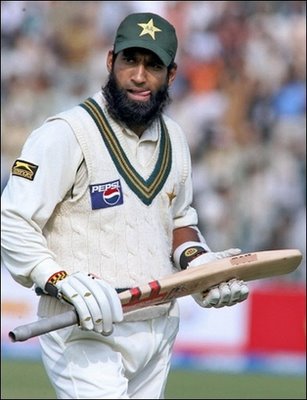
Mohammad Yousuf

Mohammad Yousuf Biography

Mohammad Yousuf formerly Yousuf Youhana, born 27 August 1974, Lahore, Punjab, Pakistan.He is a Pakistani cricketer who has been a member of the Pakistani national cricket team since 1998. He is best known for his achievement in 2006 when he broke the great West Indian batsman, Sir Vivian Richards', world record for the most Test runs in a single calendar year. Prior to his conversion to Islam in 2005, Yousuf was one of the few Christians to play in the Pakistan national cricket team. He made his Test debut against South Africa at Durban and ODI debut against Zimbabwe at Harare. He has scored over 9,000 ODI runs at an average of 43.63 (2rd highest batting average among Pakistani batsmen after Zaheer Abbas and 6,770 Test runs at an average of 55.49 (highest batting average amongst all Pakistani batsmen) with 23 Test centuries. He has the record of scoring the most runs without being dismissed in ODIs, 405 against Zimbabwe in Zimbabwe in 2002-03. He has also scored a 23-ball fifty in ODIs, and a 68-ball hundred. In Tests he has scored a 27-ball fifty, which is 3rd fastest by any player. He was top scorer during the successive years of 2002 and 2003 in the world in ODIs. In 2004, he scored a memorable 111 against the Australians in the Boxing Day Test. In December 2005, he scored 223 against England at Lahore, also earning him the man of the match award. Seven months later in July 2006, when Pakistan toured England, he scored 202 and 48 in the first Test, again earning himself the man of the match award. He followed up with 192 in the third Test at Headingley and 128 in the final Test at the Oval. Yousuf was named CNN-IBN�s Cricketer of the Year for 2006, ahead of the likes of Australian captain Ricky Ponting, West Indies Brian Lara, Australian spinner Shane Warne, South Africa�s bowling spearhead Makhaya Ntini and Sri Lanka�s Muttiah Muralitharan. He was selected as a Wisden Cricketer of the Year in the 2007 edition. Yousuf became the fourth recipient of the ICC 'Test Cricketer of the Year' award for 2007, he scored 944 runs at an average of 94.40 including five centuries and two fifties in just 10 innings and that was enough to be awarded the honour ahead of Kevin Pietersen and Ricky Ponting. Yousuf was also named in the 2007 Test team of the Year alongside compatriot Mohammad Asif. A year that started on a promising note, Yousuf carried it forward to break two world records both held earlier by West Indian great Sir Vivian Richards. The 32-year-old smashed an unparalleled 1788 runs in just 11 Test matches with the help of nine centuries. His second record was taking him beyond the Windies great yet again. Yousuf is known for his ability to score runs at exceptional rate through his great technique and composed strokeplay. Although capable of hitting the ball hard, Yousuf is quick between the wickets, although he is prone to being run out. Yousuf is a skillful infielder, with a report prepared in late 2005 showing that since the 1999 Cricket World Cup, he had effected the ninth highest number of run-outs in ODI cricket of any fieldsman. He is also distinguished by his characteristic celebration after hitting one hundred runs for his country, where he prostrates in thankfulness to Allah in the direction of Mecca. He has observed this act (known as the Sajdah) recently since his conversion to Islam.

Mohammad Yousuf

Mohammad Yousuf

Mohammad Yousuf

Mohammad Yousuf
Mohammad Yousuf
Mohammad Yousuf
Mohammad Yousuf
Mohammad Yousuf
Mohammad Yousuf Test Player Of The Year ICC AWARDS

Mohammad Yousuf 111 vs Australia Part 1

Wasim Akram

Wasim Akram Biography
Wasim Akram born 3 June 1966 is a former Pakistani left arm fast bowler and left-handed batsman in cricket, who represented the Pakistan national cricket team in Test cricket and One Day International matches.Akram is regarded as one of the best fast bowlers in cricket. He holds the world record for most wickets in List A cricket with 881 and is second only to Sri Lankan off-spin bowler, Muttiah Muralitharan in terms of One Day International wickets with 502. He is considered to be one of the founders and perhaps the finest exponent of reverse swing bowling. The revolutionary nature of reverse swing initially resulted in accusations of ball tampering by cricketcritics, although the skill of the reverse swing delivery has now been accepted as a legitimate features of ability in cricket. Akram's later career was also tarnished with accusations of match fixing by critics, although these remain unproven.On 30 September 2009, Akram was one of five new members inducted into the ICC Cricket Hall of Fame.
In 1988 he signed for Lancashire County Cricket Club in England and went on to become their most successful overseas players. From 1988 to 1998, he opened their bowling attack in their ECB Trophy, Benson & Hedges Cup and National League tournaments. He was a favourite of the local British fans who used to sing a song called "Wasim for England" at Lancashire's matches. In 1998, with Akram as captain, Lancashire won the ECB Trophy and Axa League and finished second in the championship tournament despite losing only five matches in all competitions throughout the season. Apart from the National League second division title in 2003, this was the last time Lancashire won a trophy.
Akram made his Test cricket debut for Pakistan against New Zealand in 1985 and in only his second Test match, he achieved 10 wickets in the match. A few weeks prior to his selection into the Pakistan team, he was an unknown club cricketer who had failed to even make it to his college team. He came to the trials at Gaddafi Stadium in Lahore in Pakistan, but for the first two days he did not get a chance to bowl. On the third day he got a chance; his performance convincing Javed Miandad to insist upon his inclusion in the national team. Akram was hence given an opportunity to play for Pakistan, without any significant domestic experience. Later that season he opened the bowling attack with Imran Khan, who became his mentor at and after the World Championship of Cricket in Australia.
In the 1987 Cricket World Cup, when Pakistan played against the West Indies, Akram bowled to Viv Richards in the late overs of the innings but Richards, who is regarded as the best batsman during that period, struggled against Akram's bowling performances.Akram's rise in international cricket was rapid during the late 1980s. When Pakistan toured the West Indies in 1988, he looked to be the fastest bowler between the two sides. However, a groin injury impeded his career in the late 1980s. Following two surgeries, he re-emerged in the 1990s as a fast bowler who focused more on swing and accurate bowling.
Akram was a significant figure in the 1992 Cricket World Cup held in Australia, when Pakistan won the tournament. In the final against England, his batting performance during his innings of 33 runs off 19 balls, pushed Pakistan to a respectable score of 249 runs for 6 wickets. Akram then took the important wicket of Ian Botham early on the English batting innings and when brought back into the bowling attack later on, with the ball reverse swinging, he produced a devastating spell of bowling which led to Allan Lamb and Chris Lewis being bowled in successive deliveries in one over. His excellent performances earned him the Man of the Match award for the final.
He also captained Pakistan with some success. The high points of his captaincy was the 1996-1997 victory in the World Series Cricket in Australia, two Test match wins in India in 1998-1999 and in 1999, when Pakistan reached the 1999 Cricket World Cup final. The low point was the 1996 Cricket World Cup in Pakistan and India, when he had to pull out of the quarter final match against India, citing injury. After Pakistan's defeat, there were angry protests outside his home and riots across the country from angry fans who accused the team of throwing the match and a government inquiry was launched into the failure.
In 1999, he led Pakistan to the brink of victory in the World Cup before they capitulated and was defeated by Australia in the final, by eight wickets with almost 30 overs to spare. This was the start of the match fixing controversies, as critics believed Akram had set up the match for Australia. However, none of the allegations could be proved.
He was Pakistan's best bowler in the 2003 Cricket World Cup taking 19 wickets in 7 matches. However, Pakistan failed to reach the "Super Six" phase of the tournament and Akram was one of the eight players to be sacked by the Pakistan Cricket Board as a result.
In May 18, 2003, at the age of 36, Akram abruptly announced his retirement from international cricket, ending a career which spanned 19 years. He had suggested that he was ready to quit several times towards the end of his career, but Pakistan's sub-par performance in the World Cup proved to be the deciding factor.
Prior to his retirement, he was one of eight senior players dropped for the Sharjah Cup in April 2003, and was then omitted from the Pakistan squad for the subsequent Bank Alfalah Cup triangular series. Due to his omission from the team, he did not participate in a farewell match.
Akram fulfilled his contract play for Hampshire until the end of the English season.
Wasim Akram
Wasim Akram
Wasim Akram
Wasim Akram
Wasim Akram
Wasim Akram
Wasim Akram
Wasim Akram
                                                       Wasim Akram Pioneers of Cricket 1
Wasim Akram 500th ODI wicket

Aamir Sohail

Aamir Sohail  Biography
Aamer Sohail born on 14 September 1966 in Lahore, Punjab, Pakistan.He is a former professional Pakistani cricketer and PCB Chief Selector. With Saeed Anwar, he formed one of the best opening combinations Pakistan has ever had.

Career
Sohail made his first-class debut in 1983, a left-handed opening batsman and occasional left-arm spin bowler. In a playing career that spanned eighteen years, Sohail played in 195 first-class and 261 List A Limited Overs matches, including 47 Test matches and 156 One Day Internationals for Pakistani.

Debut
An aggressive batsman, Sohail's first appeared for the national team in a 1990 one-day International against Sri Lanka and enjoyed a successful international career. He was an important member of the team that won the 1992 Cricket World Cup in Australia and New Zealand.
1996-98: Pakistan Captain
Sohail captained Pakistan in six Tests in 1998, becoming the first Pakistani captain to defeat South Africa in a Test Match. He led Pakistan through 22 One Day Internationals from 1996 to 1998, winning nine and averaging 41.5 with the bat.
Sohail played a big role in Pakistan's World-Cup triumph in 1992, famously telling Ian Botham that he might want to send his mother-in-law in to bat after Botham was controversially given out for nought in the final. Sohail's most infamous moment on the cricket field, however, was in the 1996 World Cup Quarter Final against arch rival India in Bangalore. Sohail was captaining the side in pursuit of a relatively large target of 287 in 50 overs. With opening partner Saeed Anwar, he got Pakistan off to a flying start. With the score at 109 for one, and Saeed Anwar (48) back in the pavilion, Sohail smashed a delivery from Indian seamer Venkatesh Prasad through the covers for four. Both players exchanged words, and Sohail unnecessarily pointed his finger aggressively at Prasad. The next delivery clean-bowled him and triggered a batting collapse which ultimately lost the game and eliminated Pakistan from the competition.
The loss had other causes, however, which included captain Wasim Akram withdrawing from the match for mysterious reasons on the morning of the quarterfinals. The five batsmen following Sohail, Inzamam, Ijaz, Saleem and Javed all played poorly. This match remains a controversial one, for Aamir Sohail blew the whistle about players involved in match-fixing.
Sohail was at the heart of the match-fixing scandal that rocked cricket in the 1990s: as captain of the national team, his whistle-blowing may have negatively affected his international career.


Aamir Sohail

Aamir Sohail

Aamir Sohail

Aamir Sohail

Aamir Sohail

Aamir Sohail

Aamir Sohail

Aamir Sohail

Aamir Sohail 

Aamir Sohail humiliating the bowler
                       Aamir Sohail and Ravi Shastri HOT debate On Pak India Semi Final

Saeed Anwar

Saeed Anwar Biography
Saeed Anwar born September 6, 1968 in Karachi, Pakistan, is a former Pakistani opening batsman. A left-hander, Anwar is most notable for scoring 194 runs against India in Chennai in 1997, the previous highest and now the second highest joint individual score in a One Day International. India's Sachin Tendulkar overtook Anwar's record, when he scored 200* against South Africa on February 24, 2010.
Saeed Anwar graduated from NED University, Karachi in 1989 and is an engineer by profession. He was planning to go to the United States for his Master's studies before becoming a professional test Cricketer.He faced a personal tragedy in 2001, when his daughter died after a prolonged illness. As a result he turned to religion and was seen as the turning point to the Pakistani cricket team's Islamisation that was eventually criticised for Pakistan's failure to live up to its high expectations. He made his return to Cricket after a long hiatus and was one of the most consistent Pakistani batsmen in the 2003 World Cup.

On August 15, 2003, he announced his retirement from Cricket after he was dropped from the squad for the upcoming One-Day International tournament in Sharjah. He devoted his life to preaching Islam across Pakistan with the Tablighi Jamaat. He led the funeral prayers for his ex team mate Wasim Akram's spouse, Huma Akram, in Lahore.An opening batsman capable of annihilating any bowling attack on his day, Anwar was an attacking batsman in one-day matches and once settled in Test matches, scored quickly and all over the field. His success came from good timing and wrist flicks rather than physical power, and Anwar became famous for his trademark flick. He was able to lift a ball that had pitched outside off stump for six over midwicket. Anwar's timing and ability to score quick runs made him a crowd favourite. He was named as a Wisden Cricketer of the Year in 1997.
Anwar was the first Pakistani batsman to score a century against India on Indian soil in a one-day match. He has the highest Test batting average (59.06) of any Pakistani against Australia, and once scored three consecutive centuries against them. He scored a classic century against South Africa in Durban, which allowed Pakistan to win a Test match for the first time in South Africa.
On May 21, 1997 in Chennai, Anwar scored 194 against India in an ODI match. Charles Coventry equalled the feat on August 16, 2009, against Bangladesh. This was the highest individual score by any batsman in the world till Sachin Tendulkar scored an unbeaten 200 against South Africa on February 24, 2010.
Anwar is a member of the exclusive club of batsmen who have scored three successive hundreds in ODIs, with hundreds against Sri Lanka, West Indies and Sri Lanka during the 1993–94 Champions Trophy in Sharjah. He scored two successive hundreds on three other occasions in his career, and was the first batsman to complete this feat in ODIs.
Records
Anwar (194) and Charles Coventry (194*) shared the record for highest individual score in an ODI match until it was overtaken by India's Sachin Tendulkar (200*) against South Africa on February 24, 2010. Anwar has scored two or more successive hundreds on four occasions. He holds the highest Test batting average (59.06) of any Pakistani against Australia in Test matches, and made 20 hundreds in One Day Internationals as a Pakistan opening batsman.

Saeed Anwar
Saeed Anwar
Saeed Anwar
Saeed Anwar
Saeed Anwar
Saeed Anwar
Saeed Anwar
Saeed Anwar

Saeed Anwar's 194 vs India
Sachin Tendulkar v Saeed Anwar 2010 - India v South Africa 2010, 2nd ODI, Gwalior

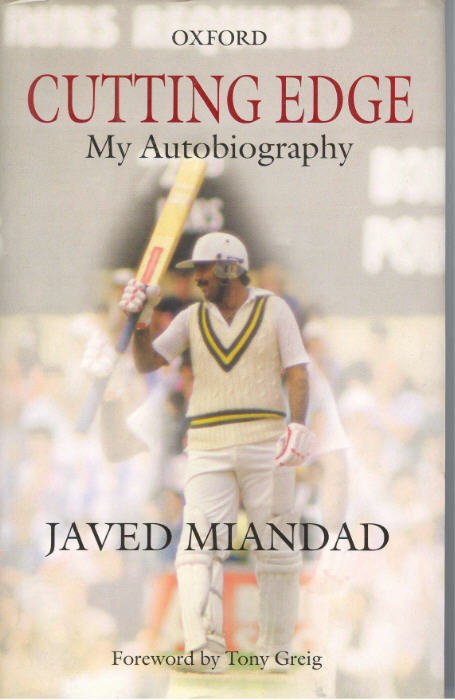
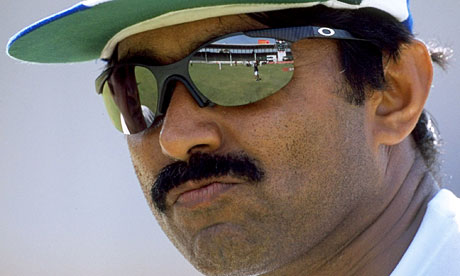
Javed Miandad

Javed Miandad Biography 
Javed Miandad is the greatest batsman Pakistan has ever produced. There was little doubt in the mind of Abdul Hafeez Kardar, Pakistan's first Test captain and influential administrator, when he first laid eyes on him as a youngster in the early 70s and famously predicted Miandad "the find of the decade." He wasn't wrong, as a stupendous debut series against New Zealand in 1976 started to prove.
Miandad was not of the classical school of batting, though he possessed a beautiful square cut and most shots in and outside the book: he was a fine early reverse-sweeper. But he worked the angles and spaces equally well; he knew above all how to score runs in almost any situation. These qualities presented themselves through his entire career and uniquely, not once did his career average fall below fifty. No Pakistani has scored more Test runs than him and, Inzamam-ul-Haq aside, probably no batsman has won as many matches for Pakistan.There was often a touch of genie or genius about his finest innings, like his two hundreds in successive Tests in the West Indies in 1987-88 or the big double hundreds against India and England. Problems on the bouncy pitches of Australia or the swinging ones of England were overcome with time and, if people questioned his record against the West Indies, they never did after that 1987-88 series.
He was versatile as well, as evidenced by a marvellous ODI career. Here his supreme running - it is said that he was one of the early pioneers of aggressive ODI running - shot placement and mental strength produced outstanding results. All qualities came together in a near-miraculous ODI century against India in Sharjah which won the Australasia Cup for Pakistan in 1986. He often saved his best for India, never more so than when he smote Chetan Sharma for a last-ball six to win that final. The match led to years of Pakistani domination over India, particularly in the deserts of Sharjah. In 1992, battling age and back problems, Miandad played a lead role in Pakistan's only World Cup triumph, with six half-centuries.
He was also Pakistan's youngest captain and always considered to be the most tactically astute. Imran Khan often acknowledges the role Miandad played as vice-captain with key on-field decisions, though the two were chalk to the other's cheese. But as captain possibly he was too abrasive to get on with all of his players, as at least two player revolts against his leadership suggest. And coinciding with the leadership of Imran, he never captained in as many Tests as he might have done. As with most subcontinent greats, he possibly lingered for longer than might have been advised, finally bowing out in 1996 after, ironically, a loss to India in the World Cup.
The problems of captaincy re-emerged when he became Pakistan's coach, where he had his ups and downs. Results were mostly positive but constant bickering from players about his excessively hands-on approach wasn't so good. After three stints in charge, he parted company with the team in 2004 to make way for Bob Woolmer after being blamed for Pakistan's one-day and Test losses to India. In October 2008, Miandad declined an offer to become Pakistan's coach again, but he was soon appointed the PCB's director-general, possibly a role of even greater influence. The move was hailed by many Pakistanis but it didn't last long - Miandad quit the job in January 2009, after differences with the board over the exact scope of his role. 
Javed Miandad
Javed Miandad
Javed Miandad
Javed Miandad
Javed Miandad
Javed Miandad
Javed Miandad
Javed Miandad

Javed Miandad's Famous SIXER @ Sharjah


Cricket-Javed Miandad and Kiran More